
In this blog, we will delve into the use of room-level utilisation data in the context of the Smart campus. At PLEQ, we believe that room-level utilisation data is the key driver for the Smart campus.

Bart Valks

What is a Smart Campus?
Before we look at room-level occupancy data, we must first discuss what exactly a Smart campus entails. In other words, what makes some campuses smart and others not?
If we zoom out and look very broadly at the use of the term "smart" to describe objects, it is used in situations where the object has an enhanced interaction with (1) its user and/or (2) other objects or environments. Think of smartphones, smartwatches, smart televisions: compared to their predecessors, they offer you more ways to interact with your device and have more options to communicate with other objects. This is achieved by more computing power, sensors and networking capabilities on these devices.
This principle has run from objects to environments: there are smart buildings, smart cities, smart stadiums, smart stations and of course smart campuses. Similarly, the addition of computing power, sensors and networking capabilities offers users an enhanced interaction. The difference is that for environments, the addition of this technology is linked to a stronger purpose. Take, for example, the broad definition of the Smart campus given in SURF's Vision on Smart campus:
"The Smart Campus is aimed at the use of data and digital technology that is specifically applied to facilitate campus users, improve space utilisation and optimise services, in collaboration with education and research."
This definition clearly links the use of technology to specific purposes, which can also be formulated as problems:
Students and staff struggle to find available spaces on campus;
Spaces on campus are underutilised, leading to a significant waste of resources;
Services are not optimally delivered due to dynamic use
The need for a Smart campus
The need for the Smart campus is directly linked to the necessity of efficient resource utilisation. This is not only from a financial perspective: higher education institutions are facing declining and more conditional funding per student, but also want to be more sustainable in their business operations. Using their buildings and spaces as effectively and efficiently as possible makes sense from both perspectives. Moreover, there is an increasing diversity in the student population and more uncertainty about the development of student populations, and after the COVID-19 pandemic, there is more variation in working on and off campus. To support their users, they want a campus that is flexible and adaptive.
A longer-term trend in Higher Education is that spaces are increasingly shared on campus. Instead of assigning spaces to departments, teams and users, spaces are shared by them and users move freely between these departments. Alexandra den Heijer describes this in her models for the future campus (Den Heijer 2025) as a shift from the traditional campus model ("solid") to the network campus model ("liquid") and the virtual campus model ("gas").
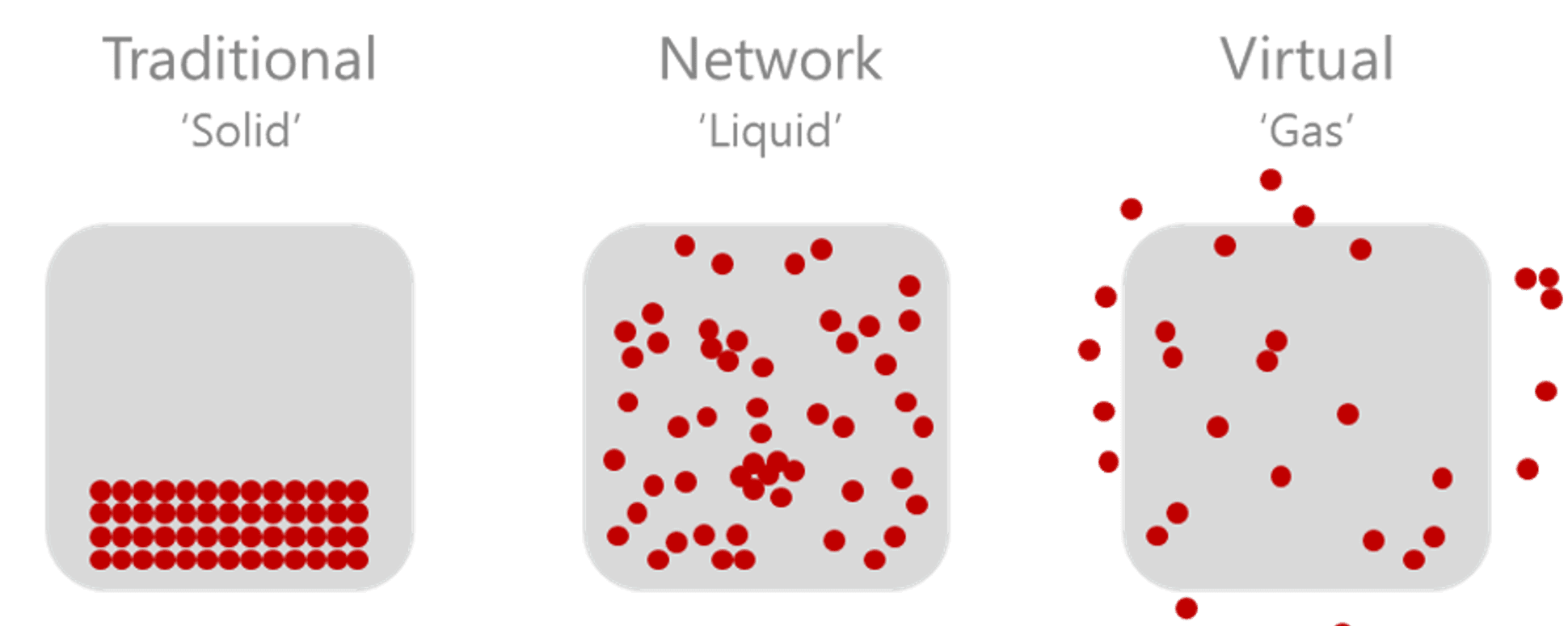
Three models for the Campus of the future (Den Heijer 2025)
This shift from the traditional campus model to a network/virtual campus model is the foundation of the need for a Smart campus. In the traditional model, the use of spaces is inefficient, because on the other hand users have their own workstation and have many meeting rooms and teaching rooms close by. Users have more knowledge about the facilities and less need for information on availability. In a network model, there is potential for much higher space utilisation, but users need help to find the available spaces, and service delivery must be optimised to where users are located. The virtual model adds an extra unpredictability: for students and staff, the question arises whether there is a place for them if they want to come to campus. And for service delivery there is the question: how many students and staff can we expect on our campus?
Occupancy data on room level to drive the Smart campus
The shift from the traditional campus model to the network and virtual campus model is why we think that room-level occupancy data is the most important data that should be added to campuses. By adding this data to a database of spaces on campus, students and staff can find the available spaces they need. Campus managers can monitor the space utilisation of teaching spaces, study areas, workstations and meeting rooms to inform campus planning and optimise space utilisation on campus. Building managers can link occupancy data to building management systems to align energy consumption with building occupancy. Facility managers can link occupancy data to cleaning, catering and security reports and planning, and better align these with the actual use of spaces.
Occupancy data on room level can therefore play a key role in the transition from a traditional campus to a network campus, giving users more flexibility and allowing the institution to achieve higher resource efficiency. At PLEQ, we help you collect and use room-level occupancy data through our Occupancy Data Platform. Want to get started on your Smart campus? Contact us now at info@pleqcampus.nl!
References
Valks, B. (2021). Smart Campus Tools: Technologies to support campus users and campus managers. A+BE | Architecture and the Built Environment, 11(18), 1–456. https://doi.org/10.7480/abe.2021.18.6146
Den Heijer, A. (2025). Campus of the future: Managing a matter of solid, liquid and gas. TU Delft OPEN Books. https://doi.org/10.59490/mg.138


