
In an innovative space such as the Smart campus and Smart buildings, lots of initiatives start as pilot projects. However, as you might be aware, lots of smart campus initiatives do not move beyond a pilot phase. Why is that? What characterizes a successful pilot? Let’s dive deeper into what we see as the critical success factors for a good pilot.

Bart Valks


Deriving the pilot goal from a larger objective
Let’s start with the question: what is a pilot? A pilot is the implementation of a system on a small part of the organization, with the intention of implementing the system in the entire organization. The objective of the pilot is to determine if the system is suitable for doing so. In the case of PLEQ, this is for example a higher education institution that wants to determine if our Occupancy data platform is suitable to achieve a higher space efficiency.
This is a valuable way of thinking. Not only does it make your pilot goal clear, it also does so in the context of your ultimate objective. That should get you started on thinking about how to get from here to your ultimate objective.
Defining the Business Case and Determining ROI
After connecting your project goal to a larger objective, you should also have a clear definition for the business case for real-time measurement of space usage for your university. You know what your potential cost savings are if you are able to use space 10 or 20 percent more efficiently. Using the pricing information for the pilot, you can also estimate what the costs would be of a portfolio-wide rollout, so now you have a much more precise business case.
During the pilot, you will continue refining your business case, as you can incorporate the entire data collection during the pilot! Over the course of 3 to 6 months, you will collect average occupancy and utilization data across thousands of classes, as well as the difference between scheduled and actual usage. Before the pilot, you were guessing at how much more efficient your space use could be; now, you have average frequency and occupancy rates across thousands of lessons. At the end of the pilot, you will know exactly what potential cost savings you can report to management.
Selecting your scope
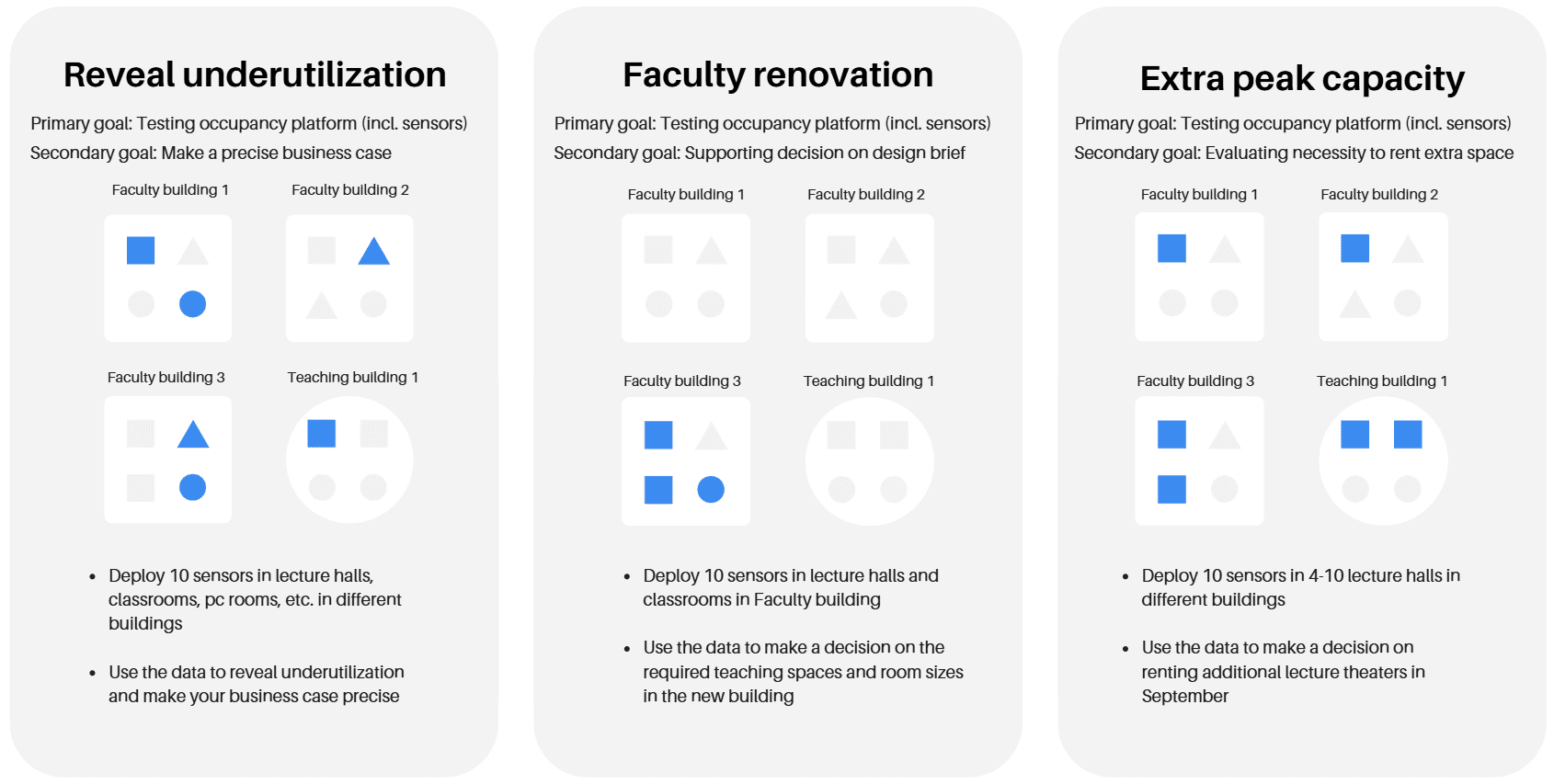
After determining our objective and business case, we have to select a suitable scope. How big should a pilot be to determine if the solution is suitable? For a pilot, approximately 10 rooms in various buildings and room types is an excellent starting point. This provides insight into how the sensors perform under different conditions and the installation variations you might encounter. Additionally, this number of rooms provides a good initial insight into space utilization at the portfolio level.
Or, even better: You might even be able to determine your scope based on a smaller, more specific business case, and use the data from the pilot to start making decisions already! For example, perhaps you can collect data in several large lecture halls to demonstrate that you don’t need to rent additional lecture theater space in the first weeks of the semester. If you can already make decisions based on your pilot scope, then might have recouped the investment in your pilot project immediately!
Project and process management
Prior to starting a pilot, make sure to have a tightly structured process in place. This means: all the involved stakeholders know which steps are being taken and when, from start to finish. They know how you will evaluate the solution, at what times the evaluations will take place, and what the next steps are following completion of the pilot.
Doing a pilot project is also an opportunity to establish your project management for smart campus projects. You gain excellent insight into how the planning proceeds, where risks lie, and what needs to be organized internally for the installation, calibration, and evaluation once the solution is live. Especially when you are from the Estates Management department, and your experience lies primarily in construction projects, we recommend to give extra attention to these aspects in a pilot project and to use the learnings for similar projects in the future.
Creating support
Once the solution is live, you can start building support! It is essential to use the pilot to introduce internal stakeholders to the technology. These can be all kinds of stakeholders – from the Director of Estates to scheduling teams, and from a faculty dean to a lecturer. With the scope as defined in this blog, you have the opportunity to gather their input without obligation, and to show them the potential value of tackling this institution-wide. If everyone pitches in and puts in some effort, the university can free up significant resources, that can be reinvested into education and research!
Are you thinking about how to structure your pilot project? Leave us a message via info@pleqcampus.nl.


