
When you start reading up on teaching space utilization, one of the first questions you might have, is: why is space utilization at my institution so low? This is often followed by: can’t we just schedule better? In this blog, we will discuss some of the reasons why improving space utilization in your institution’s schedule is not as easy as it may seem.

Bart Valks

Today, we are going to dive a bit deeper into higher education scheduling. When you start reading up on teaching space utilization, one of the first questions you might have, is: why is space utilization at my institution so low? This is often followed by: can’t we just schedule better? In this blog, we will discuss some of the reasons why improving space utilization in your institution’s schedule is not as easy as it may seem.

What you need to know about scheduling
Before we go into details, let’s start with some basics on higher education scheduling:
Scheduling in higher education is an optimization task of allocating sets of events (lectures, workshops, exams, etc.) to spaces and time slots.
The main objective is to solve the scheduling problem by fulfilling all the hard constraints and as many soft constraints as possible.
Each institution has its own unique scheduling problem: the combination of events and spaces are different, as are institutional policies and the educational systems of the countries they are located.
Finding a solution becomes exponentially more complex as the growth of the problem size increases. As a result, computers cannot find exact solutions quickly and rely on approximation algorithms. In computer science terminology, university timetable scheduling is classified as a “NP-hard” problem.
Because of the nature of the scheduling problem, your institution needs more spaces than you may think. If we stick to education timetable, a 75% frequency and occupancy rate are already considered to be good space use (SMG, 2006). In other words: if a seat in a teaching space is occupied 56% of the week (75% x 75%), it is considered good space use! Why is that? Below are four reasons why.
Reason 1: Unpredictable student enrollment versus fixed set of spaces
The first reason is at the very core of the problem: student enrollment is inherently dynamic, whereas the capacity of spaces at the university are static. If admission is not capped, the number of students entering into first-year bachelor and master programs can differ significantly from each year to the next. Even if admission is capped, the transition from first-year to second- and third-year students can change annually because of a difference in drop-out rates, student success or transfer to other study programs. The effect of this dynamic is that every year, there is a different set of group sizes for events that has to be allocated to the same size of rooms. Thus, a high utilization rate in one year does not guarantee a high utilization rate in the next year.

Reason 2: Study programs predetermine part of the scheduling solution
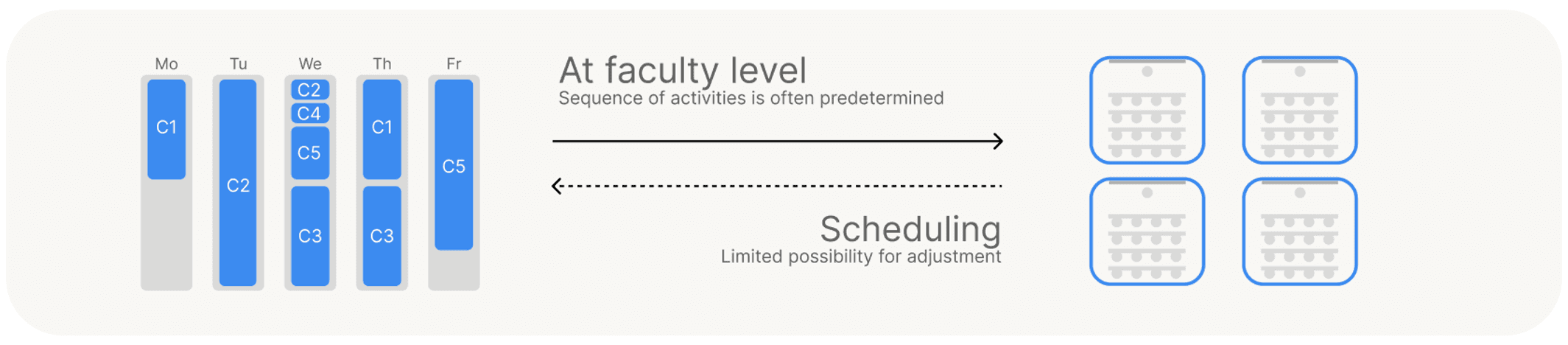
The second reason is that higher education is typically organized into study programs: most students follow a set of subjects that together make up their study program for a trimester or semester. These study programs are carefully designed and coordinated by teaching staff, and this usually includes a (rough) weekly schedule of which subject takes place at which time. Typically, the scheduling team receives this weekly schedule as set of requests to plan activities at specific times. Then, the schedulers assign these activities to specific spaces.
Because the time slots are already largely predetermined before the scheduling process starts, this creates almost by definition a suboptimal solution. Most programs want to start their trimester or semester mostly with plenary lectures, and move on to group work later. And during the week, the preferred times for lectures are between 11AM to 3PM, and definitely not on Friday afternoon. If most study programs follow the same patterns without regard for the availability of space at the desired times, this leaves the scheduling team with very little to room to maneuver.
Reason 3: Each course is subject to the availability of student and professor
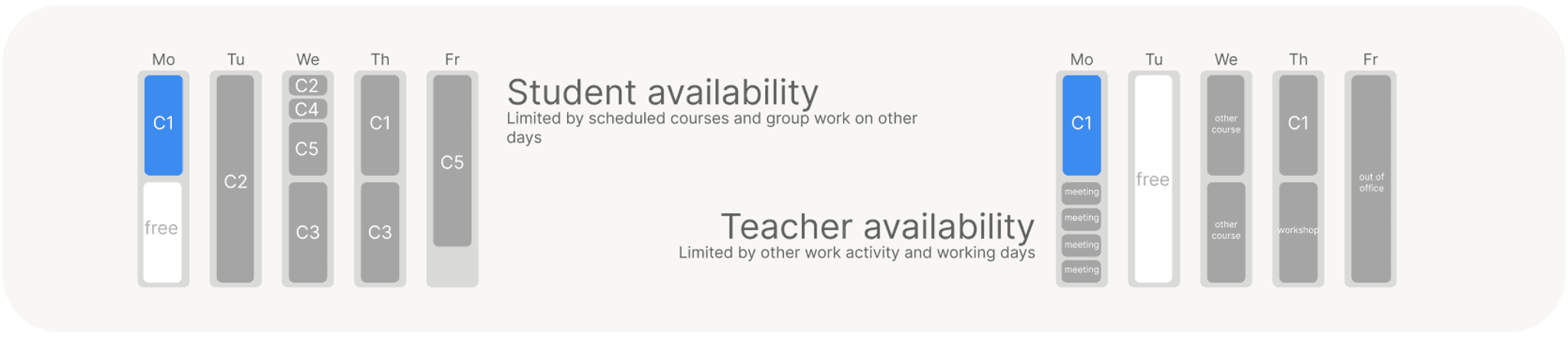
The third reason has a strong relationship to the design of study programs. A constraint that must always be satisfied in higher education scheduling is the availability of teacher and student. Students that follow an entire study program (e.g. the second semester of their Master’s degree on Linguistics) must be able to attend all activities in that study program: their schedule cannot include activities that are scheduled at the same time. Furthermore, when an activity is scheduled, the professor must be present. The time and space in which the activity is scheduled, depend on whether the professor can be at that location at that specific time.
This is what we mean by little maneuvering room for the scheduler: if there is no space available at the desired time for a specific study program, this activity can only be moved around to time slots where (1) there are no activities scheduled for the student group and (2) the professor is available.
Reason 4: Large cohort sizes require different space types
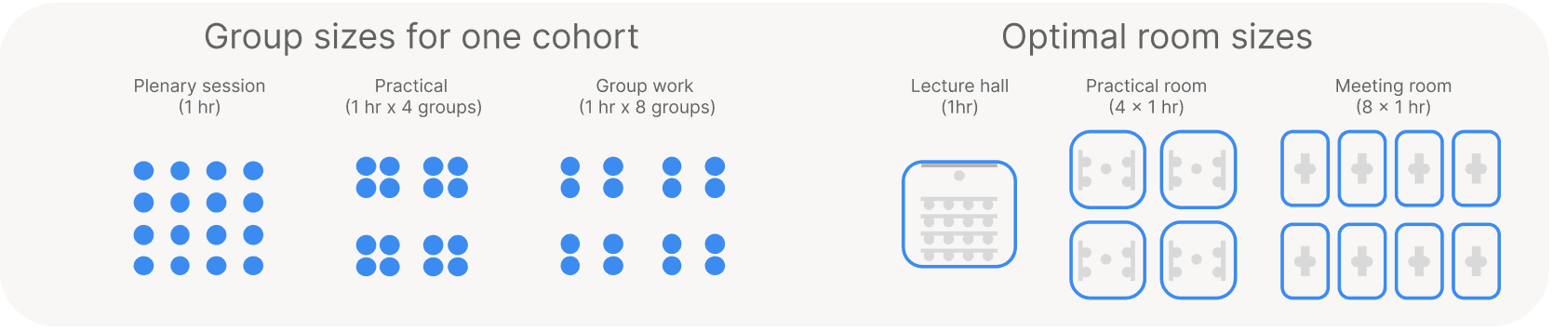
The fourth reason is that higher education deals with large cohort (group) sizes for its education programs. This is a fundamental difference between higher education and primary and secondary education which makes scheduling in higher education a different type of problem. Let’s say we have a first-year cohort size of 500 students for a Computer Science study program. It is possible to accommodate this entire group in a lecture theater for a frontal lecture, but it is impossible to host a practical instruction or supervise project groups for 500 students with one professor, in one space. In these situations, the cohort must be split into groups: for example 10 groups of 50 for practical instruction, and perhaps 50 groups of 10 for project group work.
This study program would require one large lecture theater, several classrooms for 50 people to host the practical instructions, and a lot of small meeting rooms to supervise the project groups. Even if this study would have 40 contact hours per student per week (typically this lies between 10-20 hours), then those contact hours would be spread amongst the three different room types. Now imagine all the cohort sizes of the study programs at your institution: do all those cohorts fit neatly into the large lecture theaters? And what about the instruction rooms and meeting rooms?
How to increase space utilization in your institution’s schedule
At this point, you are probably wondering: if scheduling is indeed bound by all these restrictions, how do you increase space utilization in your schedule? Ask any engineer this question, and they will answer: you have to increase the solution space for the scheduler. But how do you do this without building more spaces? At Pleq, we have the answer: by using our Occupancy data platform, you can empower schedulers to increase the solution space for each activity in the schedule. Would you like to know how this works? Contact us at info@pleqcampus.nl
Photo made by Philippe Bout (Unsplash).


