
At PLEQ, we believe that high-accuracy sensing technology forms the basis of various smart campus use cases, particularly for teaching spaces. But what is high accuracy? How do we determine it? In this blog post, we guide you through our view on assessing sensor accuracy.

Bart Valks

Measuring Frequency and Occupancy
Let’s start with what we are trying to measure. Using sensing technology, we want to understand the frequency rate and occupancy rate of spaces on your campus. These are defined as follows:
Frequency is the time that a space is in use relative to its availability.
Occupancy is the number of people using the space relative to its capacity.
At the level of a single measurement, this means we want to understand the following variables:
Frequency: Is the space in use (yes or no)?
Occupancy: How many people are using the space (number of people)?
From many measurements to lesson or meeting statistics
With real-time measurement, we then need to aggregate multiple measurements to determine the frequency and occupancy of meetings or teaching classes. Let’s say that a meeting has a one-hour duration. If the sensor measures every minute, than we have to derive the frequency and occupancy of that meetings from 60 measurements!
With people counting sensors, we start by mapping the people count across a whole meeting. This look like the example below: the people count starts at 46, peaks at 116, and after 50 minutes decreases to nearly 0.
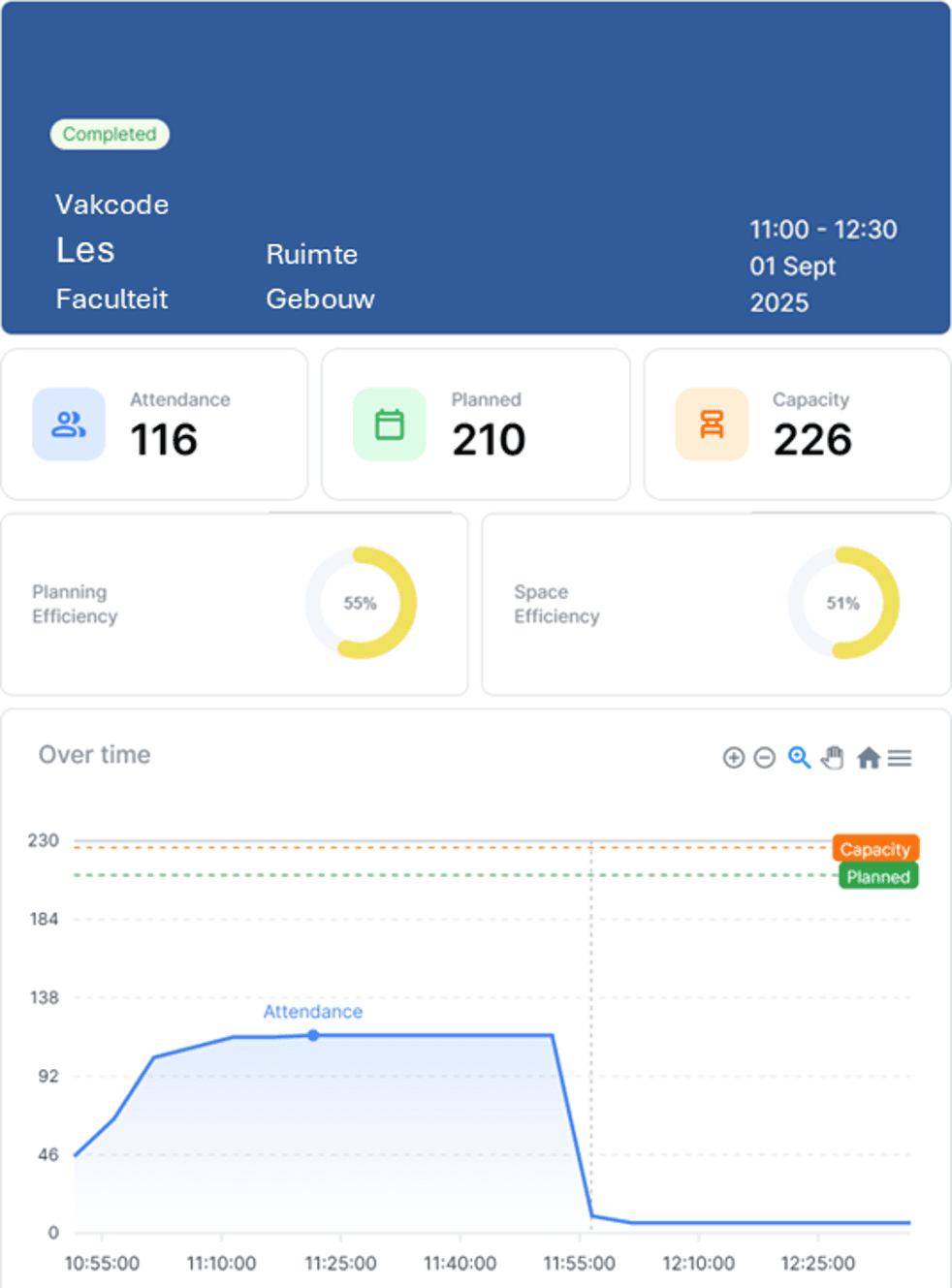
Next, we exclude the start and end of the meeting: because people move in and out of the room at these times, these counts are likely not representative of the actual number of attendees. Then, from all the measurements, we take the measurement with the highest number of attendees to determine the occupancy of the activity.
After mapping the occupancy, we determine the frequency by looking at the percentage of time that the lesson is below a threshold of the expected group size. In the example, which has a large group size, we take a threshold of 5%. The planned group size is 210: this means if the group size drops below 10, the room is considered not to be in use anymore. And as you can see, this is from 12:00-12:30, which means that the frequency of this activity is around 67%.
The accuracy of real-time measurements versus manual surveys
The ability to use many measurements to determine the frequency and occupancy of activities is one of the great advantages of real-time measurements versus manual surveys. If you have to rely on just one manual measurement every hour or two hours for every room, you may easily under- or overestimate both the frequency and the occupancy of each lesson. Also, within each block, you are unable to spot late starts or early finishes. For the previous example, a manual surveyor who passes by at 11:40 would come to an entirely different conclusion than at 12:00! As a result, the accuracy of real-time measurement of frequency and occupancy greatly increases when compared to manual measurement – provided that the sensor is accurate, of course.
Evaluating sensor accuracy
Finally, we come to the point of sensor accuracy. Accuracy is defined as follows:
Accuracy measures how close your data comes to being correct by comparing the value of the measurement to the real value (also known as the “ground truth”).
Typically, the accuracy of a people counting sensor is assessed by conducting manual measurements at a specific timestamp (for example 16:03) and comparing those measurements to the measurement reported by the sensor at the same timestamp, or the nearest adjacent timestamp. However, our objective with the sensor is not to measure the people count, but to determine the occupancy of the room. Therefore, we compare the resulting occupancy number instead of just the people counts. This has the added benefit of accounting for the room size: in order to achieve the same accuracy, a sensor in a 30-seat room has a smaller margin of error than a sensor (or set of sensors) in a 500-seat capacity room.
Using the Mean Average Error (MAE), we’ve compared the accuracy of sensor occupancy measurement across four institutions. The table below shows the results per room size. As you can see, our sensors deliver 92-99% accurate occupancy measurements across this sample size.
Room size | # Rooms | # Measurements | MAE | Accuracy % (1 – MAE) |
10 | 4 | 56 | 4.5% (0.45 person) | 96.5% |
16 | 2 | 97 | 8.8% (1.4 people) | 91.2% |
30 | 1 | 47 | 4.9% (1.5 people) | 95.1% |
138 | 1 | 36 | 1.2% (1.7 people) | 98.8% |
500 | 1 | 46 | 1.2% (5.8 people) | 98.8% |
With high-accuracy sensor data, you can make decisions regarding your scheduling and campus with confidence. Want to know more about sensor accuracy? Leave a message at info@pleqcampus.nl!


